Programs were burned onto ROM chips that were mounted inside plastic cartridge casings that could be plugged into slots on the console. When the cartridges were plugged in, the general-purpose microprocessors in the consoles read the cartridge memory and executed whatever program was stored there.
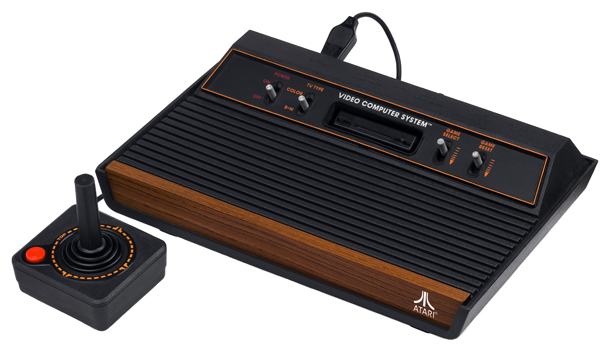
The Video Computer System (VCS) ROM cartridge-based console, later renamed the Atari 2600, was released in 1977 by Atari. The Atari 2600 would quickly become the most popular of all the early consoles.
The Intellivision, introduced by Mattel in 1980. Though chronologically part of what is called the "8-bit era", the Intellivision had a unique processor with instructions that were 10 bits wide (allowing more instruction variety and potential speed), and registers 16 bits wide. The system, which featured graphics superior to the older Atari 2600, rocketed to popularity.
The ColecoVision, an even more powerful machine, appeared in 1982. With its port of arcade game Donkey Kong included as a pack-in, sales for this console also took off.
Golden Age of Video Arcade Games
Arcade machines became prevalent in mainstream locations such as shopping malls, traditional storefronts, restaurants and convenience stores.
Space Invaders sold over 360,000 arcade cabinets worldwide, and by 1982 generated a revenue of $2 billion in quarters. Namco's Galaxian sold over 40,000 cabinets in the United States, and Atari released Asteroids which sold over 70,000 cabinets.
During this time RGB color graphics became widespread. At the same time, arcade video games began shifting away from single-screen titles towards scrolling games. Several developers were also experimenting with pseudo-3D and stereoscopic 3D using 2D sprites on raster displays.
The game that had the biggest impact on popular culture in North America was Pac-Man.
Popular Arcade Games
Space Invaders
Lunar Lander
Asteriods
Battlezone
Mario Bros
Defender
Pac-Man
Phoenix
Tempest
Donkey Kong
Frogger
Tron
Genre Innovation
The golden age of arcade video games reached its peak in the 1980s. The age brought with it many technically innovative and genre-defining games developed and released in the first few years of the decade.
Some of these include: Action-adventure games, Action Role-playing games, Adventure games, Beat'em up/Shoot'em up, Fighting games, Hack and Slash, Platformers, Racing, Rail Shooters, Real-time Strategy, Stealth games, Survival horror, and others.
Third Generation Consoles
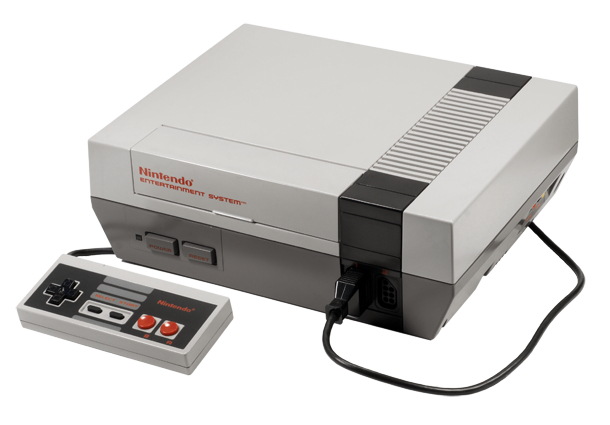
In 1985, the American Video Game Console market was revived with Nintendo’s release of its 8-bit console the Nintendo Entertainment System (NES). It was bundled with Super Mario Bros. and instantly became a success.
The NES came out ontop in America and Japan, but the Sega Master System sold better in Europe and Brazil. The NES sold 61 million units world wide were the Sega Master System only sold 12 million.
The hardware of the third generation was vastly improved from its predecessors. RAM was introduced for the consoles, higher resolutions were supported, higher color palette and more simultaneous colors, and higher quality audio.